QiaoQiao Pet Festival 2026: London Fashion Learns to Walk Beside Its Dogs
At Shoreditch’s Tab Centre, eight emerging designers, eighteen reconstructed looks and around twenty dogs turned a charity runway for StreetVet into a joyful argument for care, community and a more pet friendly London. The eighteen runway looks were reconstructed from donated second hand garments, with no new fabric introduced by the project. StreetVet, a UK charity providing free veterinary care to the pets of people experiencing homelessness.
At the Tab Centre in Shoreditch, the most magnetic runway entrances did not arrive on cue. They paused to inspect the room, turned towards familiar voices, accepted a treat and, in at least a few cases, decided that the audience was more interesting than the intended direction of travel.
That gentle unpredictability became the spirit of QiaoQiao Pet Festival 2026. Held on Sunday 26 July, the charity fashion event brought models and dogs onto the same runway while raising funds for StreetVet, the UK charity providing free essential veterinary care and support to the pets of people experiencing homelessness.
It would have been easy to treat the idea as a novelty. Instead, the festival built something more thoughtful: an emerging designer showcase, a photography exhibition and a community gathering shaped around the bond between people and their animals.
The dogs were not dressed as fashion accessories or transformed into miniature versions of the models beside them. They arrived as themselves, wearing familiar harnesses, leads and occasional personal accessories, free to move at a pace that felt comfortable.
That decision altered the entire rhythm of the show. Fashion runways usually depend on precision, repetition and control. Here, the human participants had to listen. A model might slow down, wait, crouch, redirect or simply share the moment. The result was less polished in the conventional sense and far more alive.
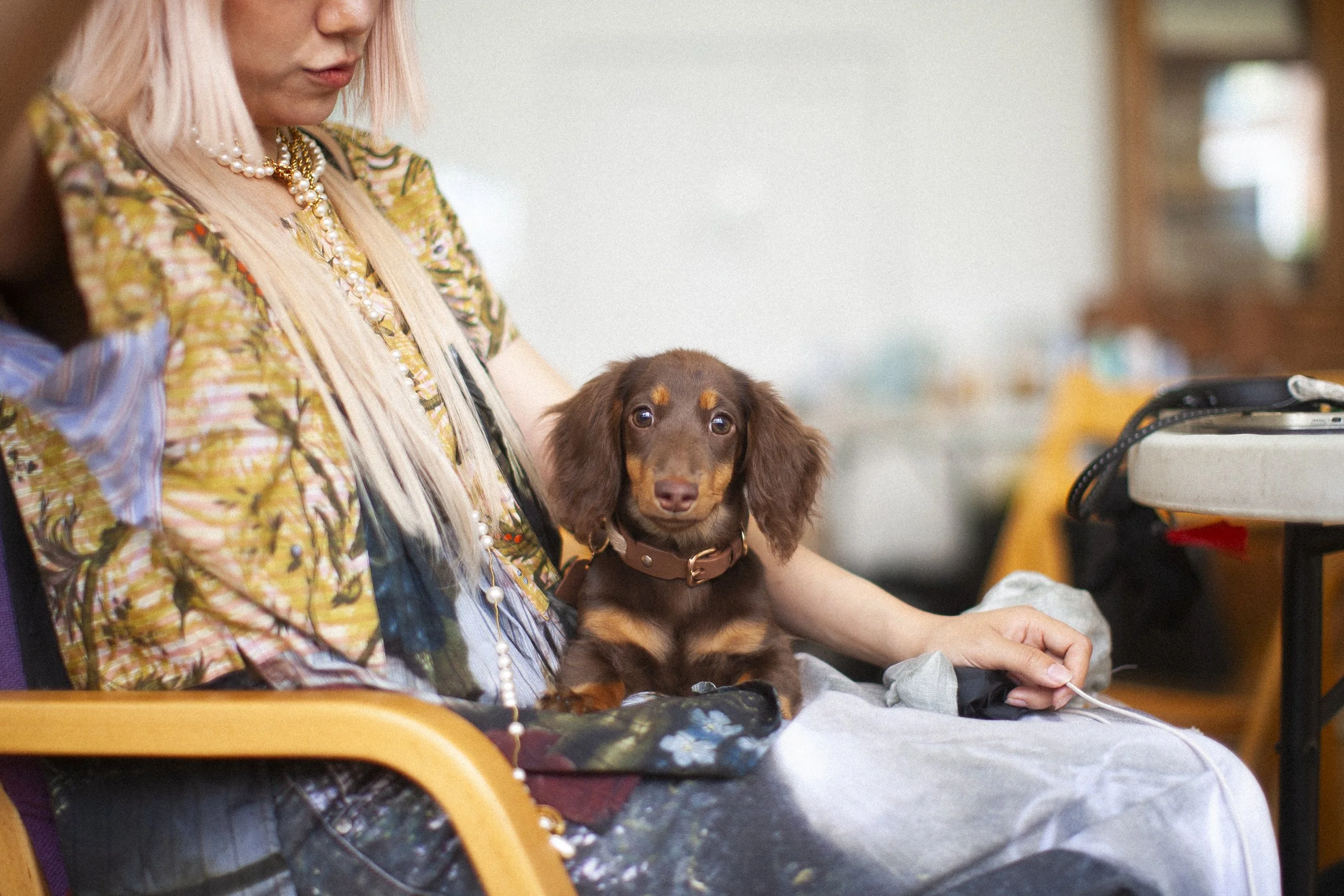
Photo: Dmi Vas

Before the runway
The experience began long before the evening audience took its seats.
Dog owners arrived during the afternoon, giving each animal time to settle into the Tab Centre, meet its model and become familiar with the runway. The rehearsal schedule allowed two hours for the dogs to explore the venue before final preparations began. In the back garden, the atmosphere felt closer to a relaxed London dog social than a backstage holding area.
Spaniels, poodles, shiba inus and smaller companion dogs moved between owners, models and members of the production team. Some played. Others watched from beneath long trouser hems or found a quiet patch beside a familiar pair of shoes.
Treats from Hide & Seek London quickly became part of the rehearsal language, rewarding curiosity and helping the dogs build positive associations with the unfamiliar space. The London pet lifestyle brand produces freeze dried treats for cats and dogs, including chicken, duck and goose liver varieties. Hide & Seek London
This consideration mattered. A genuinely pet friendly event is not created simply by allowing dogs through the door. It is created by thinking about their time, comfort, movement and ability to step away.
QiaoQiao’s rehearsal structure recognised that participation should not come at the expense of welfare. The dogs brought personality to the production, but they were never asked to surrender it.

Photo: Dmi Vas
Eight designers, eighteen second lives
The fashion came from eight emerging designers connected to the Royal College of Art, Central Saint Martins and London College of Fashion.
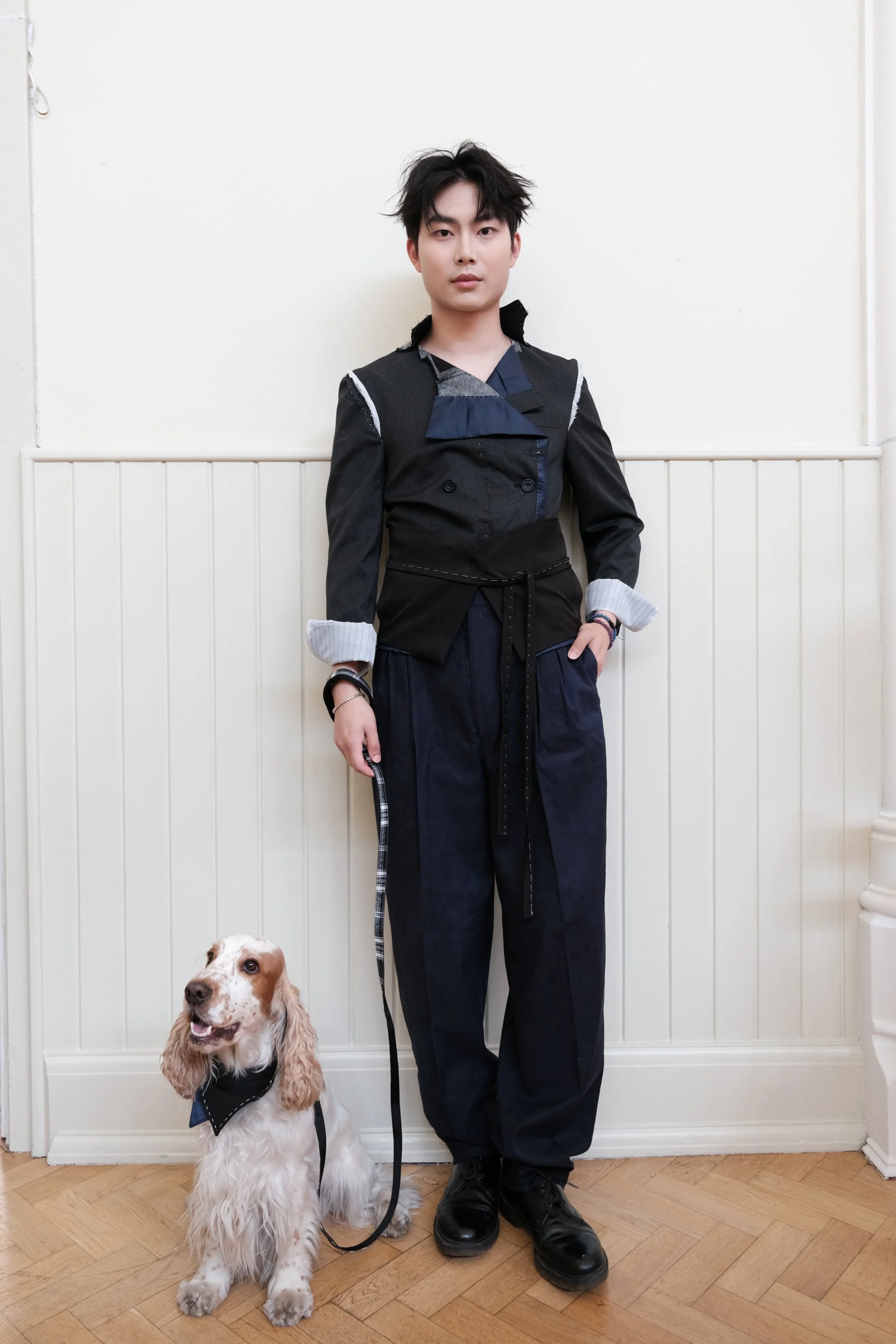
Across eighteen looks, donated second hand clothing was cut, reconstructed and reimagined through a workwear inspired lens. The organisers stated that no new fabric was introduced for the runway, positioning reconstruction as both a creative restriction and an environmental principle. Instagram
The collections shared an interest in visible process. Tailored jackets were interrupted by contrasting panels. Sleeves, seams and lapels shifted away from expected positions. Denim appeared sliced, extended and assembled into new structures.
Utility codes met costume, performance and conceptual dressing, producing garments that looked built through experimentation rather than cleaned of every trace of making.


Design lead Linxi Liu brought experience spanning the Royal College of Art, Leeds Fashion Week and Shanghai.
Yidan Gu connected contemporary fashion with the discipline of traditional tailoring. Her background includes study at Central Saint Martins and the Royal College of Art, alongside Savile Row experience.
Shuwen Nie brought a Shanghai perspective, previous experience connected to Vogue China and current postgraduate study in costume design at London College of Fashion.
Yishan Li, Zhimin Ye and Mingjie Ding each approached clothing through the MA Costume Design for Performance at London College of Fashion, where garments are considered in relation to movement, character and space.
Jiyoung Park contributed the material sensitivity of an MA Fashion Design Technology graduate. Her wider practice examines slow fashion, emotional storytelling and textile processes including knitting, tufting and embroidery.
Rujing Qian worked across garment design, styling and visual storytelling, bringing a multidisciplinary perspective to conceptual clothing and reconstructed form.
Together, the designers gave the runway a productive tension. These were clothes made for human bodies, but shown beside animals who could not be choreographed into fashion’s usual hierarchy.
The dogs softened some looks and sharpened others. A severe black silhouette became unexpectedly tender beside a spaniel. Patchworked tailoring felt more grounded when the person wearing it had to hold a lead, carry treats and respond to another living being.
The garments still commanded attention, but the image no longer belonged to fashion alone.

A runway with a purpose
All net proceeds from the evening were directed to StreetVet.
The charity works across the UK to provide free veterinary treatment, medication, essential supplies and practical support to pets whose owners are experiencing homelessness. Its teams include qualified veterinary professionals who take essential care directly into communities where conventional access to treatment may be impossible. StreetVet
Its work recognises a reality that is often absent from public conversations about housing insecurity. For many people, an animal is family, security, routine and the most consistent relationship in their life.
That made the pairing of fashion and animal welfare more than a theme. The runway supplied visibility, ticket revenue and an audience. StreetVet supplied the reason the platform mattered.


Photo: Dmi Vas

A festival built from remembrance
QiaoQiao Pet Festival’s origin begins with a dog who is no longer here.
The festival takes its name from Qiao Qiao. In 2024, the project began in Taiwan, where seven participating bars transformed signature cocktail sales into contributions towards medical care for senior dogs and cats.
The second edition crossed continents. A community market in Hackney welcomed 231 visitors and raised £395 for Battersea Dogs and Cats Home.The 2026 Shoreditch edition marked the project’s third year and its most ambitious format to date.Growth, in this context, did not mean making the project less personal.
The dog portraits remained taped to the wall. Owners still carried toys and treats from home. Models still spent time meeting their canine partners before stepping into the room. The scale increased, but the emotional logic stayed close to the ground.

Photo: Dmi Vas

A more pet friendly London
By the end of the evening, the strongest image was not a single look. It was the group itself: designers, models, organisers, owners and dogs gathered together, some facing the cameras and others looking everywhere else.
For London’s dog lovers, that imperfect group portrait said something hopeful. A more pet friendly city is not only made through designated spaces, water bowls or branded experiences. It is made when cultural events adapt their behaviour, share their platforms and recognise animals as part of the communities already moving through them.
QiaoQiao Pet Festival offered fashion without asking the dogs to become fashionable.
It allowed emerging designers to show ambitious work while keeping care at the centre of the production. It gave an afternoon to photography, a garden to play, a runway to companionship and its proceeds to animals whose access to treatment depends on collective support. In Shoreditch, for one warm Sunday, fashion did not simply make room for dogs. It changed its pace to walk beside them.


Image by Cecilia
Event Credits:
Programme Producer: Hsin-Yu Chang @nana_chy_
Exhibition Curators: Liwen Xu @kkk_dli, Xinwen Liu @daisyaoaoo
Assistant Curators: Zijia Feng @jiayuoo_, Jingyi Zeng @tracy.explores, Zhixiang Wang @cannibal379
Runway Assistant: Ziyi Xiong @melodyxzy
Public Relations: Yu Hsuan Chien @green_0503
Design Lead: Linxi Liu @minrisot
Designers: Yidan Gu @guyidan6, Mingjie Ding @nora_dmj_, Rujing Qian @luxiq_qian, Zhimin Ye @_minn_and_my_works_maybe_, Shuwen Nie @shuwendesign, Yishan Li @ella.shannnn, Jiyoung Park @op0o0do
Artistic Advisor: Hafay Canglah @hafaycanglah
Exhibition Design Advisor: Ziqi Cao @ashiii_zcao
Main Visual: Shih Chien University, Breeze Shih, Wei Kei Wu and Ping Feng Lin @f_d_m_official @f_sdc_
In Aid Of: StreetVet UK @streetvetuk_