
Film never really disappeared from fashion photography. If anything, its slower pace, imperfect texture and physical process have become more distinctive in an image culture dominated by digital precision.
But choosing a film camera for fashion is less about chasing a particular "film look" and more about understanding how the camera changes the way a shoot happens. A medium-format system encourages a slower, more deliberate frame. A compact 35mm camera can make backstage, street-style and location work feel immediate and spontaneous.
From studio portraiture to fashion editorials and candid work, these are five film cameras that continue to make sense for fashion photography.

1. Hasselblad 500C/M
Best for: considered fashion editorials, portraiture and studio photography
Few cameras embody medium-format photography quite like the Hasselblad 500C/M.
The camera shoots a square 6×6 frame on 120 film and uses a modular system of interchangeable lenses, viewfinders and film backs. Its leaf-shutter lenses also allow flash synchronisation across their shutter-speed range, making the system particularly useful when working with controlled lighting. But specifications only explain part of its appeal.
Looking down into a waist-level finder creates a very different relationship between photographer and subject. Shooting tends to become slower and more composed. Rather than continuously capturing frames, you begin constructing them.
In fashion photography, that restraint can work beautifully. Clothes, gesture and negative space are given room to exist within the square frame, producing images that often feel sculptural rather than hurried.
The 500C/M is particularly compelling for editorial portraits, beauty work and controlled fashion stories where the image is being deliberately built.
Why choose it: modular design, 6×6 negatives, excellent lenses and a deliberate working process.
Consider something else if: you need something fast, lightweight or discreet for constantly moving subjects.
2. Mamiya RZ67
Best for: studio fashion, beauty and highly controlled editorial photography
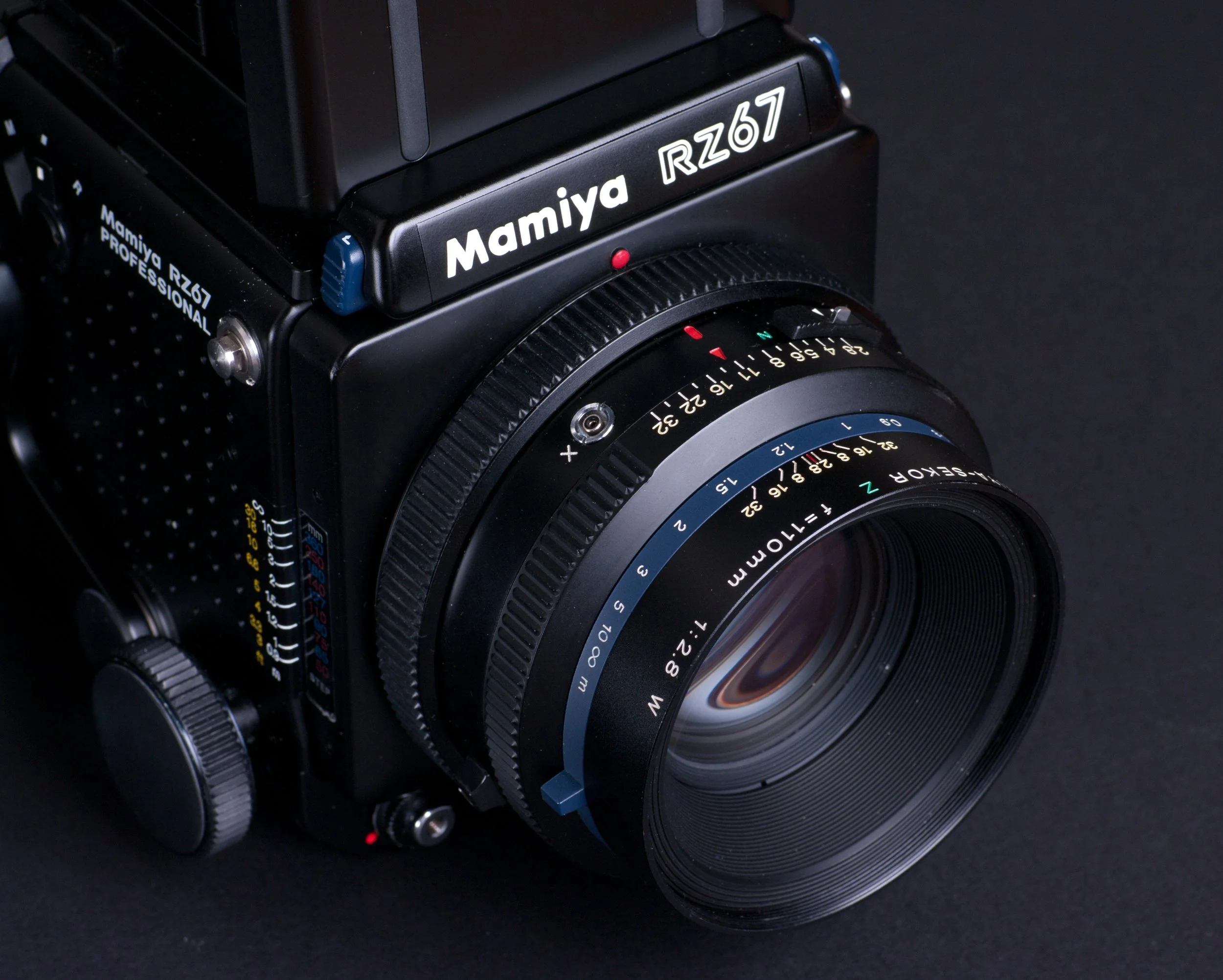
If the Hasselblad encourages deliberation, the Mamiya RZ67 practically demands it.
The RZ67 produces a large 6×7 negative on 120 film and was designed around professional studio work. Its rotating film back allows photographers to move between horizontal and vertical compositions without turning the entire camera, while its bellows focusing system makes precise framing particularly useful for portraits, beauty and close work. It is also a physically substantial camera.
That makes it less appealing for photographers walking across a city all day, but in the studio its size becomes less important. On a tripod, surrounded by lighting, styling and a carefully considered set, the RZ67 feels entirely at home.
The large negative captures remarkable detail in fabric, skin and texture, while the proportions of the 6×7 frame lend themselves naturally to portrait-oriented editorial images.
There is also something about the camera's pace that suits fashion production. Styling is adjusted. Lighting is refined. The model settles into position. Then the photograph is made.
Why choose it: large 6×7 negatives, rotating back, close-focusing ability and excellent studio versatility.
Consider something else if: portability matters. The RZ67 is not a casual walk-around camera.

3. Pentax 67
Best for: location fashion, editorial portraiture and photographers who prefer SLR handling
The Pentax 67 occupies an interesting position between the studio world of medium format and the familiarity of a traditional 35mm SLR.
It produces a 6×7 negative, but instead of the box-like form of many medium-format systems, the camera handles more like an oversized SLR. For photographers moving from 35mm into medium format, that familiarity can make the transition surprisingly intuitive.
Its best-known pairing is arguably the 105mm f/2.4 lens, prized for portraiture and its distinctive rendering.
For fashion photographers, the Pentax becomes particularly interesting on location. It gives you the depth and detail associated with a large medium-format negative while allowing a more fluid style of shooting than some studio-oriented systems.
It is still heavy, and ten frames from a roll of 120 film encourage restraint, but it can move through a location shoot without feeling quite as anchored to the tripod.
For environmental portraits, outdoor fashion stories and editorial photography where the subject needs some freedom to move, it remains a compelling system.
Why choose it: 6×7 image quality with familiar SLR-style handling and exceptional portrait lenses.
Consider something else if: you depend heavily on fast flash synchronisation or need a genuinely lightweight system.

4. Leica M6
Best for: backstage, documentary fashion and intimate location photography
Not every fashion image needs the scale of medium format.
The Leica M6 is a manual-focus 35mm rangefinder built around a very different philosophy: small camera, minimal interruption.
That can be particularly useful backstage, during fittings, on location or when photographing a subject in a way that feels closer to documentary photography than a formal fashion production.
Its size changes the dynamic of a shoot. Without a large camera between photographer and subject, moments can feel less staged and movement can remain more natural.
The M6 is not the camera to choose because you want enormous negatives or a studio system. Its strength is immediacy.
Used with a 35mm or 50mm lens, it is well suited to fashion stories that rely on atmosphere, environment and the moments happening around the clothes rather than only the finished pose.
Why choose it: compact size, quiet operation, excellent lenses and an unobtrusive approach to photographing people.
Consider something else if: you prefer autofocus or want the additional detail of medium format.

5. Contax T2
Best for: candid fashion, street style, travel and behind-the-scenes photography
The Contax T2 approaches film photography from almost the opposite direction to the RZ67.
It is compact, autofocus and designed to be carried almost anywhere.
Built around a fixed 38mm f/2.8 Carl Zeiss Sonnar lens, it became associated with a certain kind of polished but spontaneous 35mm photography. In fashion, that makes it particularly useful when the photographer wants to react rather than construct.
Think arrivals, hotel rooms, backstage moments, street style, travel editorials or the quieter frames made between the main setups.
Its compact dimensions can also change how people behave around the camera. A large professional system announces that a photograph is about to happen. A small camera can sometimes catch the moment before everyone becomes conscious of being photographed. That difference can be as important as image quality.
Why choose it: portability, strong fixed lens, autofocus and an effortless point-and-shoot workflow. Consider something else if: you want interchangeable lenses, manual control over every part of the process or medium-format resolution.
35mm or medium format for fashion photography?
There is no single best film format for fashion photography because the two formats encourage different kinds of pictures.
35mm generally makes more sense when movement and spontaneity matter. Cameras such as the Leica M6 and Contax T2 are easier to carry, give you more exposures per roll and work naturally for backstage, travel, street-style and documentary-led fashion stories. Medium format slows things down.
The Hasselblad 500C/M, Pentax 67 and Mamiya RZ67 create considerably larger negatives and encourage a more considered approach to composition. They are particularly effective when detail, portraiture, beauty, fabric and controlled lighting are central to the image. Neither is inherently more "professional".
The better question is what kind of relationship you want between the camera, the subject and the shoot.
Which film camera should you choose?
For a studio fashion or beauty shoot, start with the Mamiya RZ67.
For a slower, composed editorial portrait, the Hasselblad 500C/M remains difficult to beat.
For medium format on location, look at the Pentax 67.
For documentary, backstage and intimate portraiture, consider the Leica M6.
And when you want something small enough to keep with you throughout an entire shoot, the Contax T2 offers an entirely different kind of freedom.
Ultimately, the best film camera for fashion photography is not necessarily the one with the largest negative or the most famous reputation. It is the camera whose limitations suit the way you want to make photographs.
Film forces choices. That may be precisely why it continues to feel relevant.
Analogue at HUMBLE
Film remains part of HUMBLE's visual language, from medium-format portraiture to submitted fashion editorials produced on 35mm and 120 film.
