IAMISIGO’s Sacred Ecologies Turns the Body Into a Living Archive
For SS27 at Copenhagen Fashion Week, Bubu Ogisi transforms reclaimed fibre, ancestral knowledge and sculptural craft into a study of land, memory and resistance.
Some collections approach ecology as surface:
an earth-toned palette, a plant fibre, a language of responsibility. IAMISIGO’s SS27 collection begins somewhere more demanding. Sacred Ecologies treats the body as part of the landscape and cloth as a living record, carrying knowledge that has survived through movement, memory and human touch.
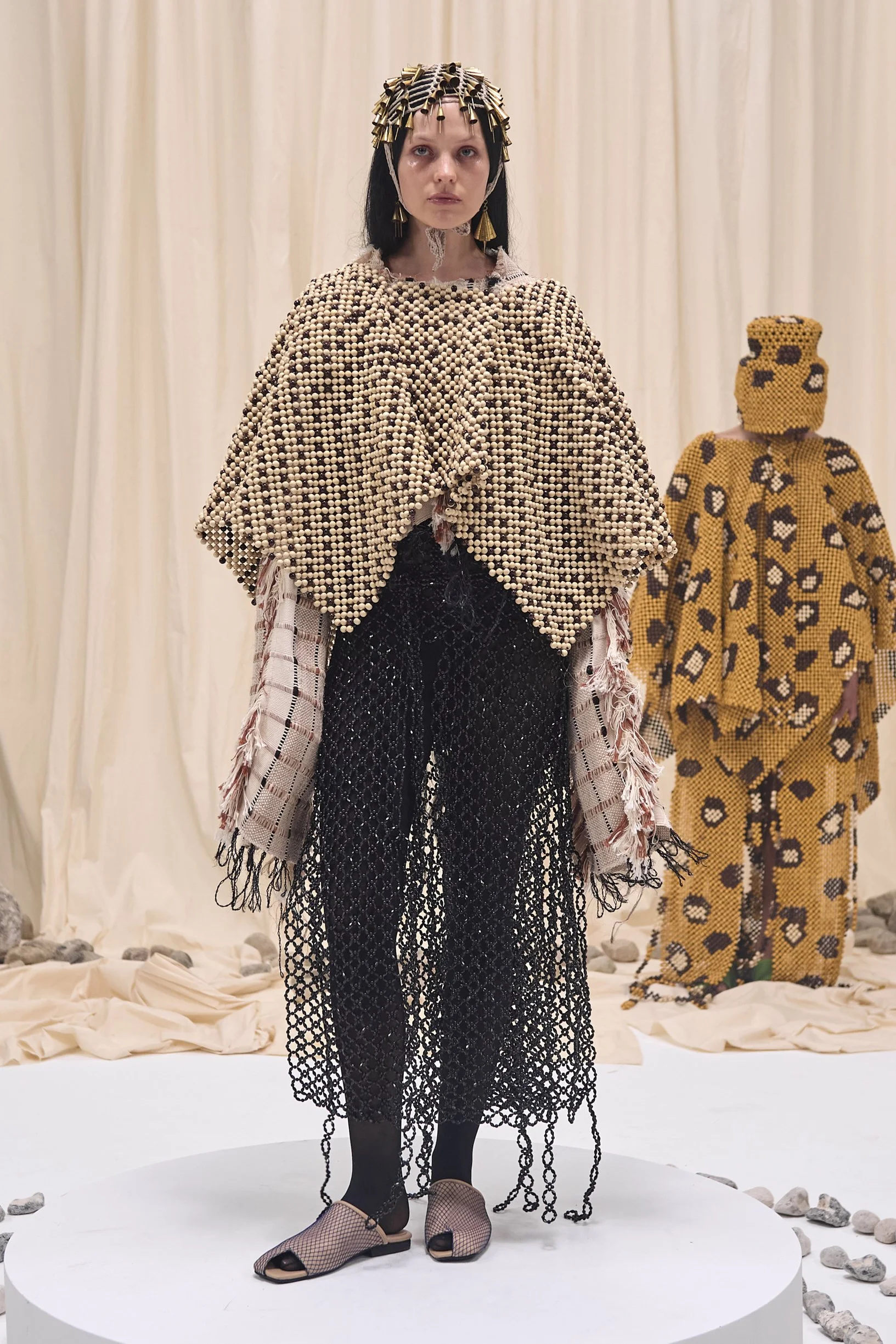
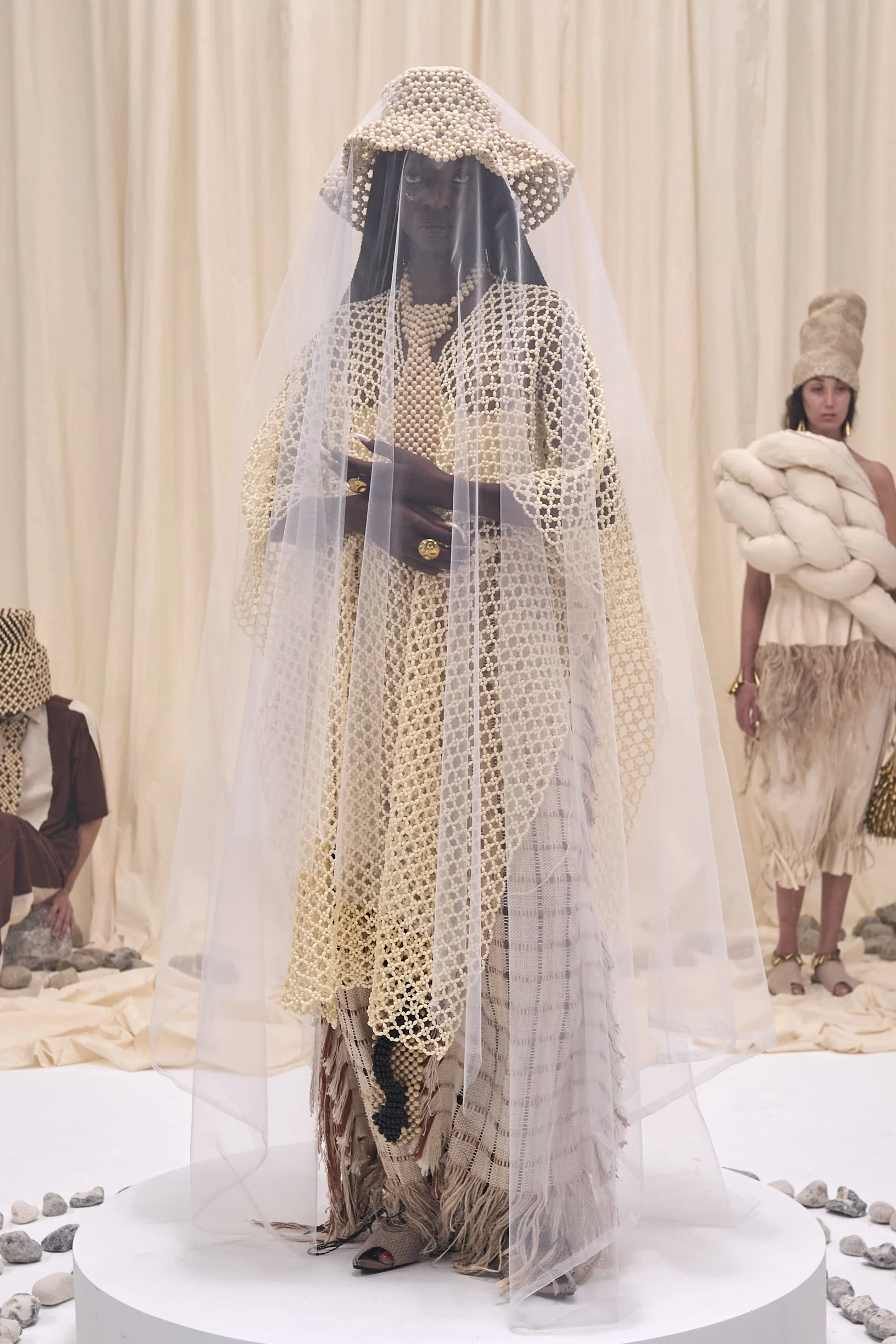
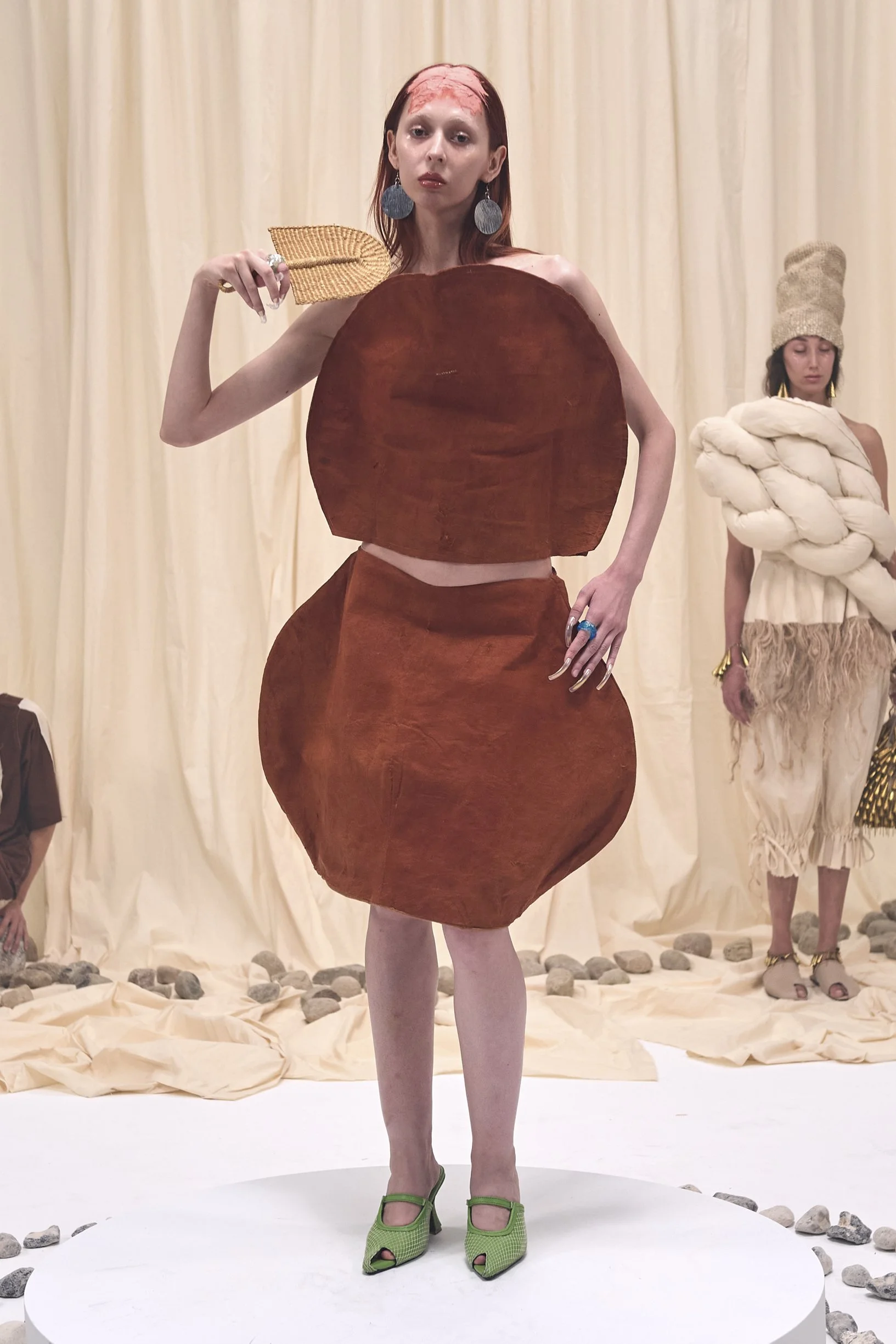
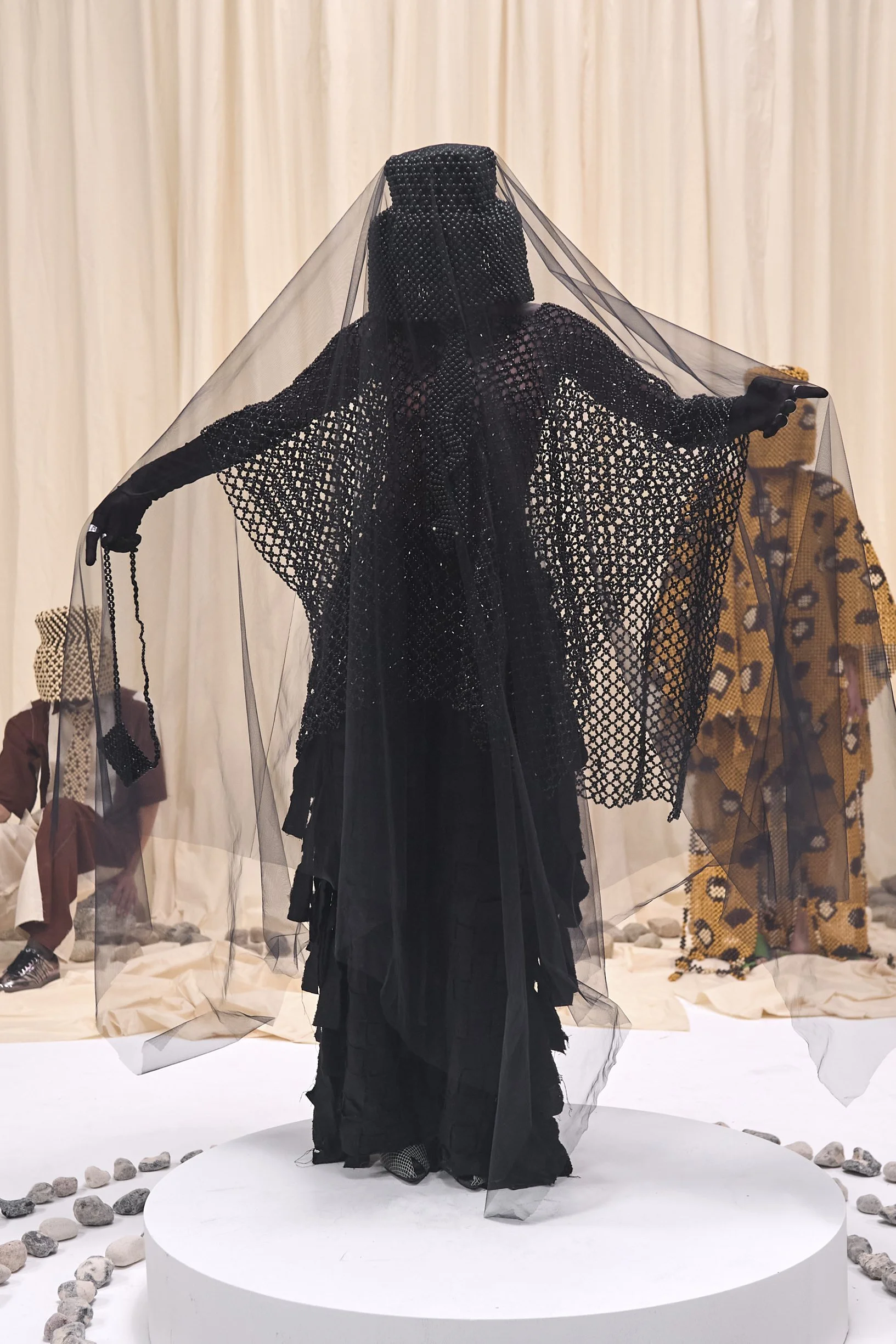
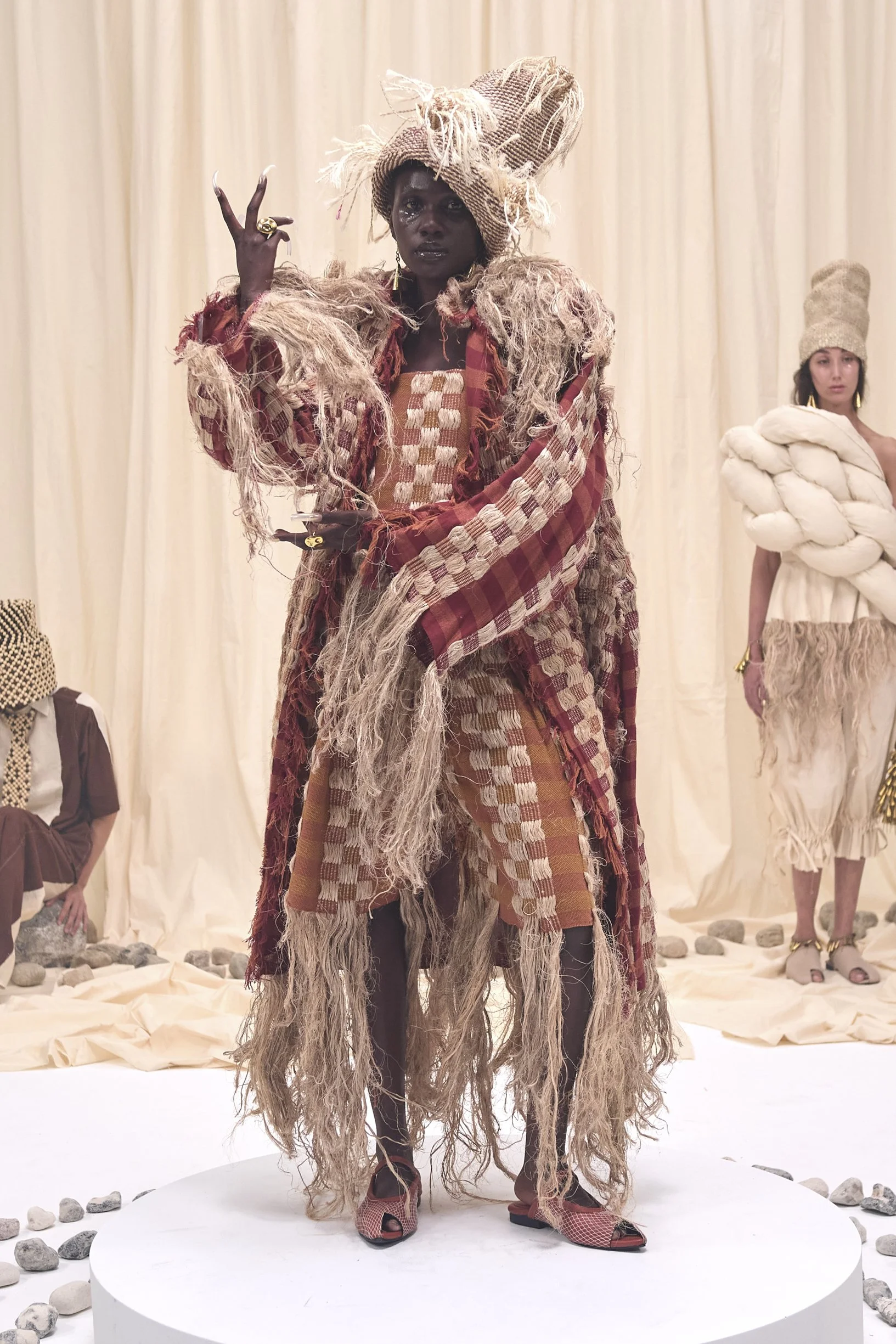
Presented at The Lab in Copenhagen on 6 August 2026, the collection gathers sculpture, dress, ritual and political imagination into figures that feel less styled than summoned. Models occupy white circular platforms inside a pale, fabric-lined landscape, surrounded by stones and other bodies waiting at its edges. The effect is closer to an installation than a conventional runway.
Founded by Nigerian designer and artist Bubu Ogisi, IAMISIGO operates across Lagos, Nairobi and Accra. Its work moves between fashion, textile research and wearable art, grounding experimentation in specific materials, places and systems of making. Sacred Ecologies continues that practice while asking how clothing might express a relationship between body, land and power.
The silhouettes answer through scale.
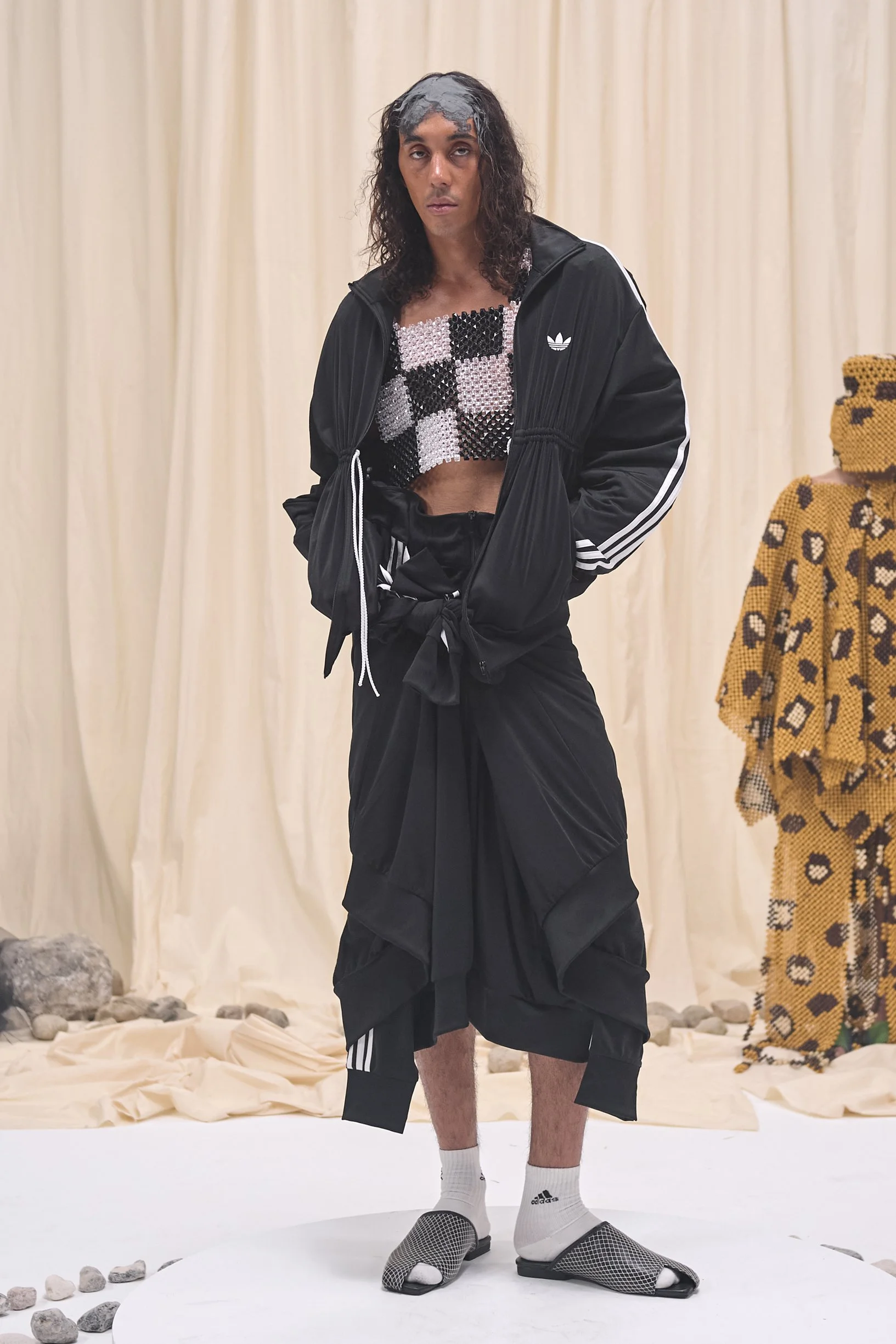
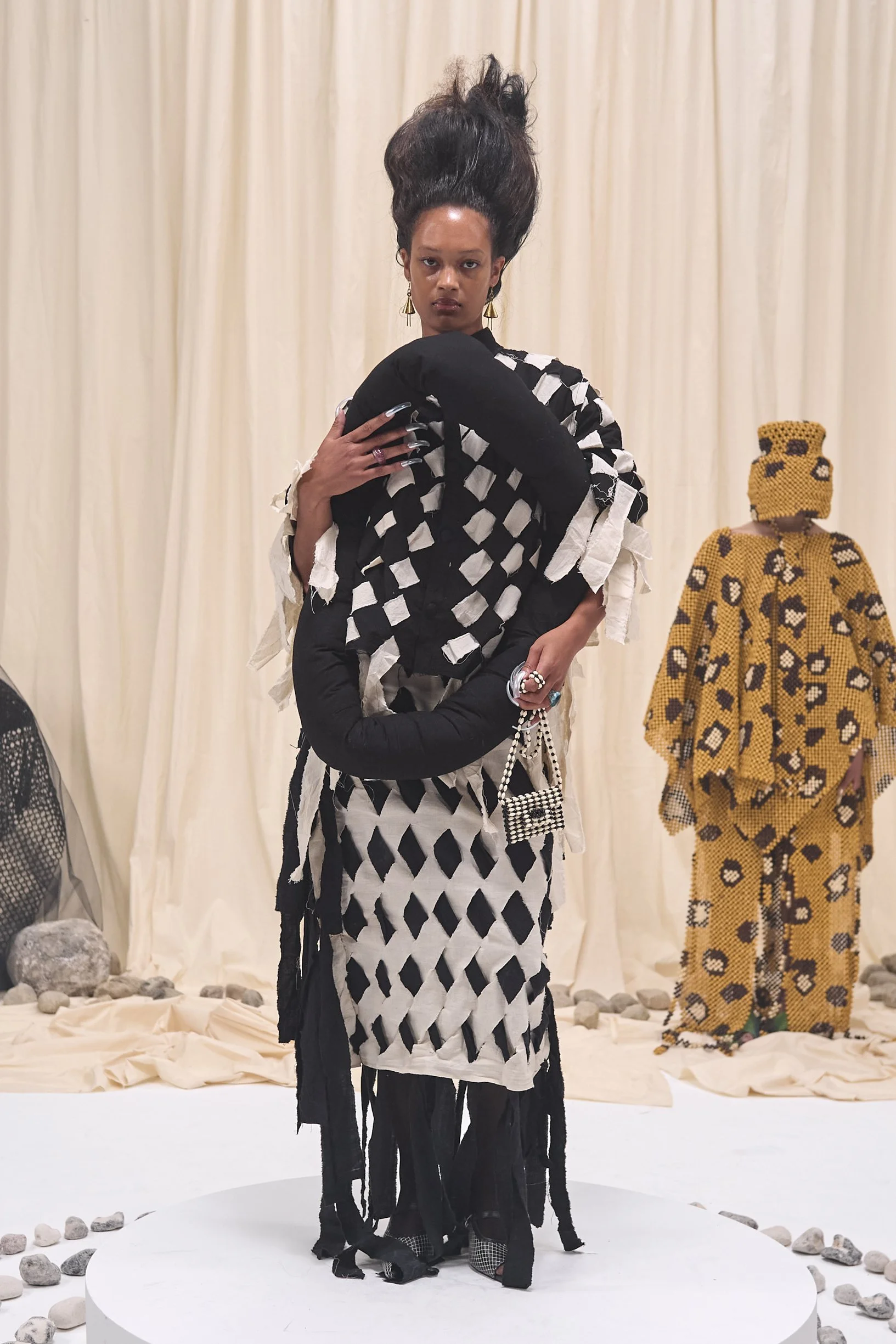
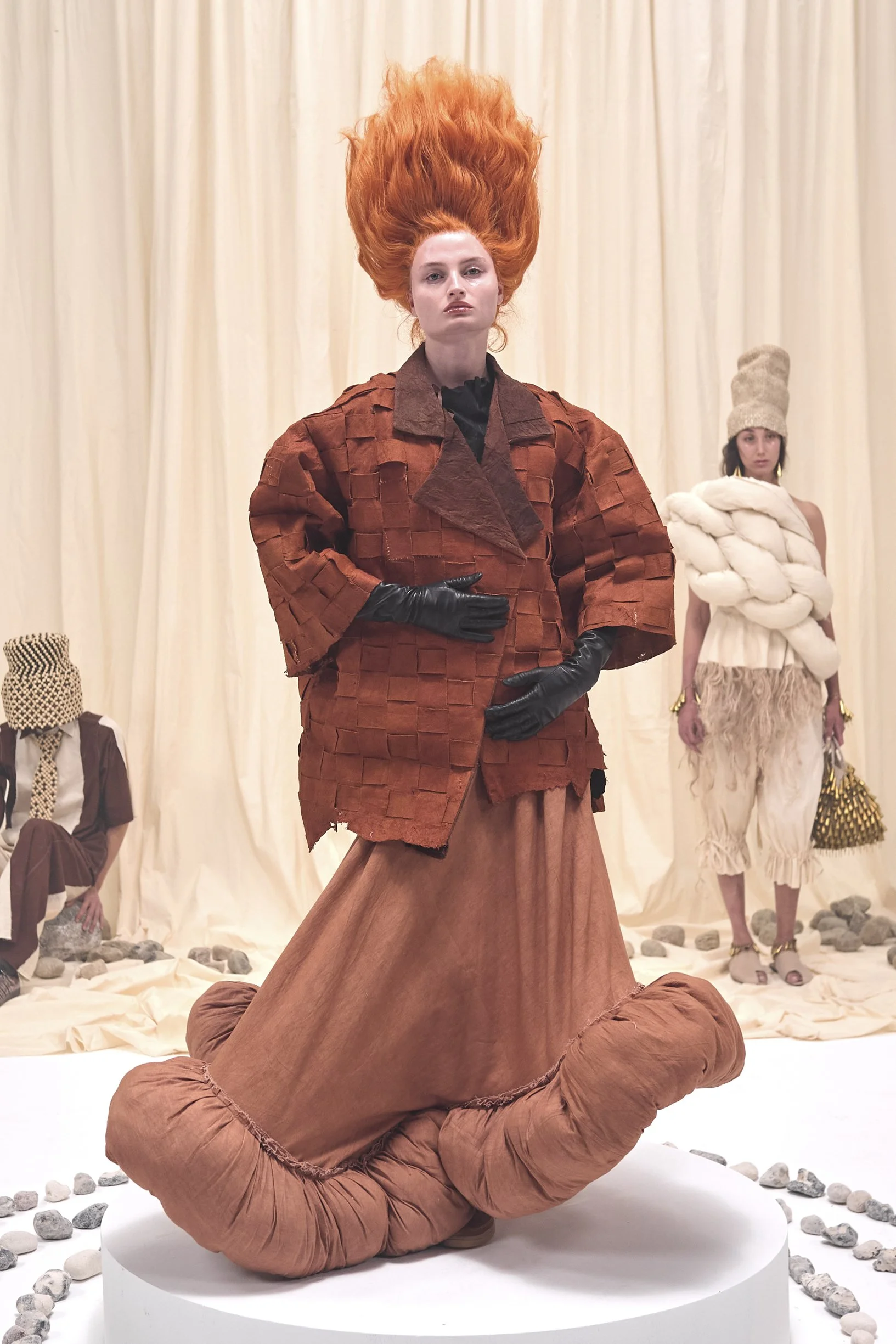
Cream fibres gather around the body like protective growth. Fringed surfaces appear wind-worn and alive. Black mesh becomes a veil, a wing and a shifting second skin. Rust-coloured structures project away from the shoulders and hips, turning the figure into its own architecture. Elsewhere, silver discs catch the light like overlapping scales while graphic checks create a visual grid across dresses, trousers and sculptural wraps.
Nothing appears entirely settled. Bodies are covered, exposed, enlarged and obscured. Some are given towering woven headpieces. Others disappear beneath hoods or open networks of fibre. A mustard-coloured figure, fully enclosed in a patterned textile, looks simultaneously human, animal and archetypal. These forms do not illustrate nature. They suggest bodies whose identities are being shaped by their environment in real time.
According to the collection notes, the material vocabulary includes banana fibre sourced from Uganda, cotton and wooden beads from Nigeria, sisal from Tanzania, recycled aluminium from Kenya, recycled glass, natural dyes and other reclaimed fibres. Weaving was carried out in Kenya. Remaining yarn was returned to crochet work, while offcuts were reincorporated into textured outerwear.
The importance of these materials lies not only in what they are, but in how visibly they have been handled. Surfaces retain irregularity, tension and evidence of labour. Threads hang loose. Fibres knot, gather and resist uniformity. Craft is not used to decorate an otherwise finished garment. It determines the garment’s structure, behaviour and meaning.
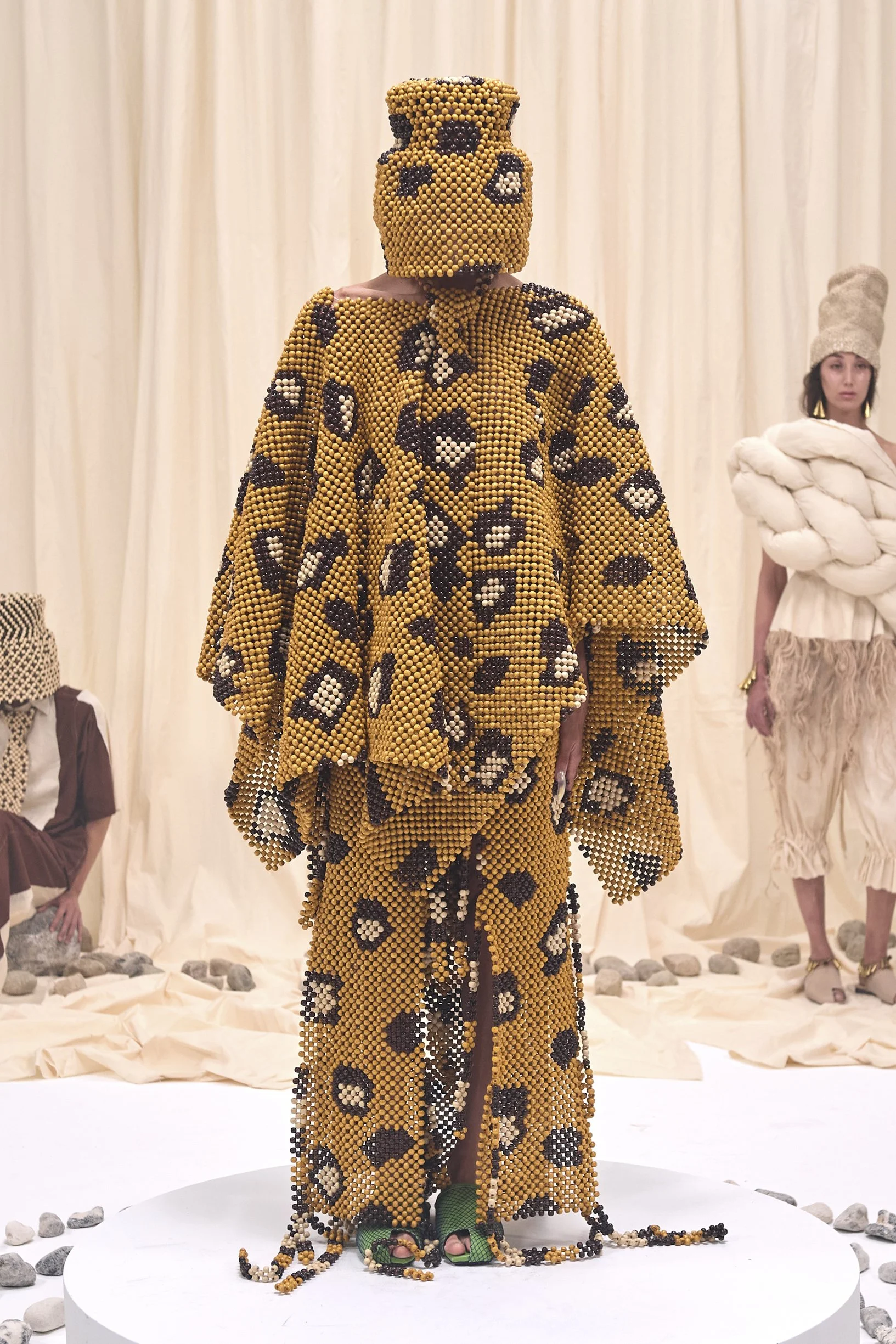
A central reference is the lukasa, the Luba memory board. Traditionally associated with the Luba peoples of what is now the Democratic Republic of the Congo, a lukasa is a hand-held wooden object through which political histories, territories and cultural knowledge can be interpreted. Its arrangement of beads, shells, carved forms and markings works as a conceptual map rather than a written document. The Metropolitan Museum of Art describes the lukasa as simultaneously a historical record, territorial diagram and expression of spiritual knowledge.
Sacred Ecologies translates this principle from object to body. Its most structural garments operate like portable maps, holding information through texture, weight, repetition and form. The installation expands that idea further, placing each figure within a larger landscape of connected nodes.
The collection’s political framework is informed by Ngũgĩ wa Thiong’o’s Wizard of the Crow, a satirical novel set in the fictional state of Aburĩria. Through magical realism, Ngũgĩ examines dictatorship, inequality, resistance and the stories through which power maintains itself. In IAMISIGO’s interpretation, environmental destruction cannot be separated from political control because land and people are subjected to the same systems of division.
This makes Sacred Ecologies more than a study of lower-impact materials. It presents ecology as a question of who controls knowledge, who is permitted to define progress and which forms of memory are allowed to endure. Ogisi’s wandering bodies carry knowledge precisely because it has not been fixed inside a single institution. It moves through people, objects, fibres and places.
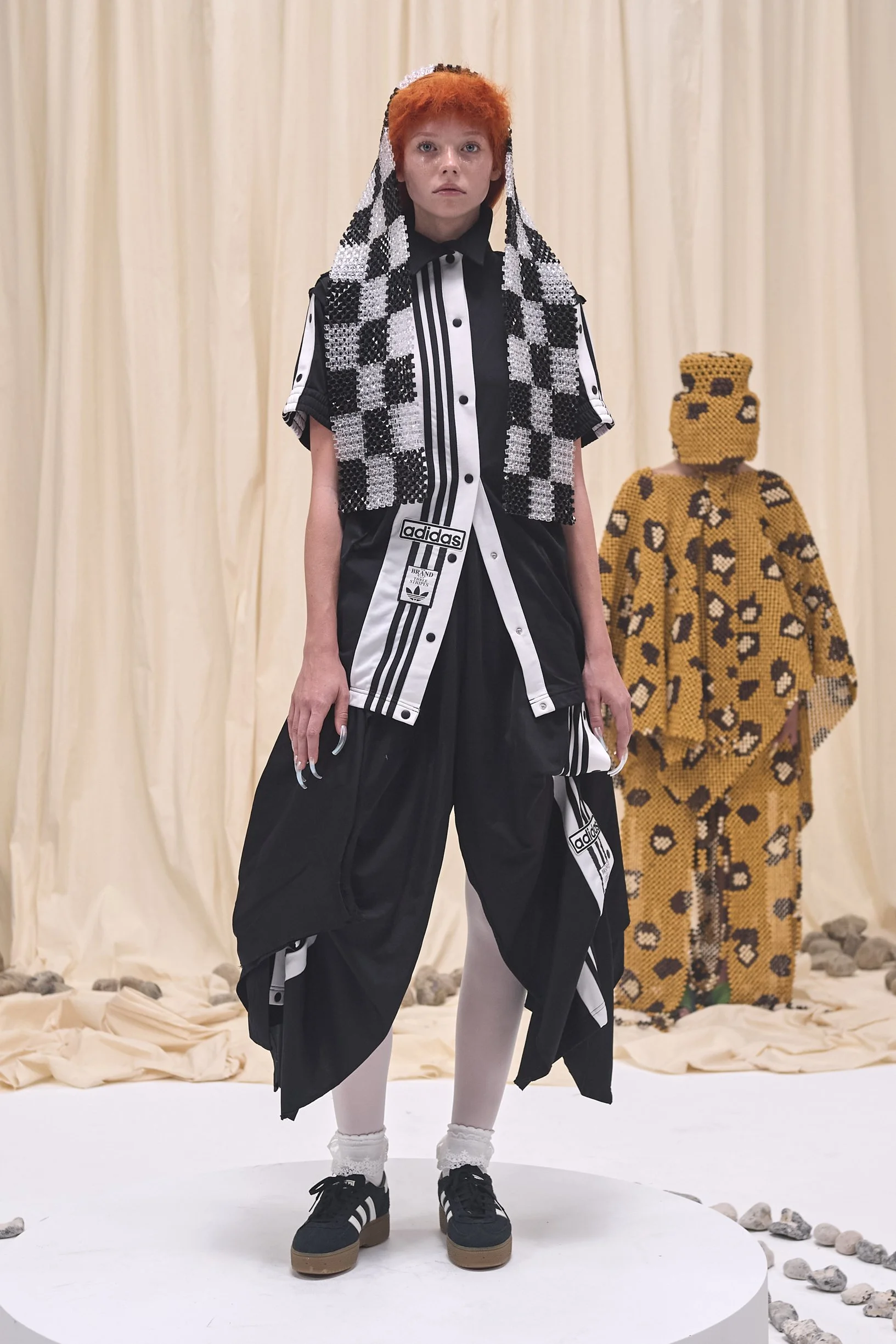
A collaboration with Adidas through a deconstruction table adds another layer.
Familiar sportswear codes are taken apart and placed beside hand-worked fibres, netting and sculptural forms. Rather than allowing a global brand language to dominate the collection, IAMISIGO absorbs it into its own system of reconstruction.
The result is a collection that refuses to treat African material culture as a static archive of references. Sacred Ecologies is interested in knowledge as something active, adaptive and capable of resisting confiscation. Its garments do not preserve the past by holding it at a distance. They place memory directly onto the body and allow it to move.
At Copenhagen Fashion Week, IAMISIGO did not offer a simplified vision of nature or sustainability. It proposed something more complex: that ecology can also be a relationship between land, imagination, political freedom and the knowledge carried from one body to another.
IAMISIGO appeared on the official Copenhagen Fashion Week SS27 schedule. The label was the Zalando Visionary Award winner for 2025 and was named among the 2026 LVMH Prize semi-finalists. The supplied press release and credits were also reviewed in full.
Credits
Runway Photography: James Cochrane - Creative Director: Bubu Ogisi - Collection Stylist: KK Obi - Project Management: Grâce Bomoua - On-Ground Production Lead: Zeda the Architect - Creative Assistants: Annika Kausch and Soline Charrier - Styling Assistant: Laetitia Aeschbach - Production Assistant: Benn Waigand - PR and Communications Liaison: Not Just Another Agency - Art Direction and Set Design: Standard Practice - Executive Producer: Tushar Hathiramani - Casting Director: Emma Mattell, Director MA World Group and Emma Mattell Casting